
Category: Education

  • Mistakes to Avoid when Writing an Essay

    Mistakes to Avoid when Writing an Essay

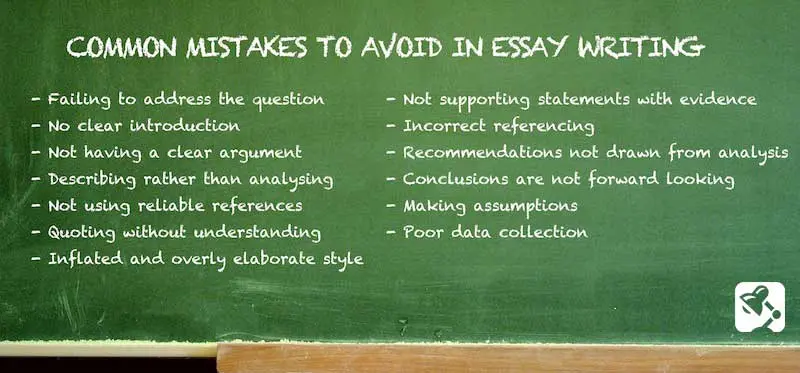
    Writing an essay can be a daunting task for even the most well-written individuals. Students may find themselves wondering what to write about, how to structure their thoughts, or even how to start their essays.

    However, there are a few common mistakes that can make writing an essay much more difficult than it needs to be. By avoiding these mistakes, students can set themselves up for success.

    What are the Most Common Mistakes in Essay Writing?

    As a student, you know that essay writing can be a daunting task. But by avoiding the following common mistakes, you can set yourself up for success:

    • Not knowing what to write about

    While it is certainly true that having a clear idea of what to write about is important, it is also worth noting that this is not always easy to achieve. This can be especially true for students who feel lost and unsure of where to begin.

    In such cases, brainstorming a list of potential topics can be an effective way to get the creative juices flowing and narrow down your options until you find a topic that feels right for you. Once you have a strong idea in mind, you can start crafting your essay with confidence, knowing that you have a clear direction to follow.

    • Ignoring your professor’s instructions

    Ignoring your professor’s instructions when writing an essay is a terrible idea. When professors assign papers, they do so with the expectation that students will follow the directions.

    Not following directions shows a lack of respect for the professor and the assignment. It also indicates that the student is not willing to put in the effort to understand what is expected.

    In addition, ignoring instructions can lead to a lower grade. After all, if the student does not follow the basic instructions, it is likely that the essay will be poorly written and researched.

    Furthermore, the student may miss out on important points that the professor hoped to see in the essay. In short, ignoring your professor’s instructions is a surefire way to get a lower grade and cause frustration all around.

    So next time you’re assigned an essay; be sure to read the directions carefully and follow them to the best of your ability. It’ll save you a lot of trouble in the long run.

    • Not taking the time to proofread

    This step should never be skipped, as it can mean the difference between a good grade and a bad one. Proofreading allows you to catch any errors in grammar, spelling, or punctuation that you may have made.

    It also lets you ensure that your essay is well-organized and flows smoothly. If you do not proofread your essay, you run the risk of turning in a paper that is full of errors.

    This will not only reflect poorly on you as a student, but it will also make your professor less likely to take your work seriously. So be sure to take the time to proofread your essay before you submit it

    • Not having enough evidence to support your claim

    When writing an essay, it is essential to back up your claims with evidence. This means that you need to find reputable sources that support what you are saying.

    If you do not have enough evidence to support your claims, your essay will come across as unsubstantiated and weak. This can make it difficult to convince your reader of your point of view and could result in a lower grade.

    To avoid this, be sure to do some research before you start writing. This way, you will have plenty of evidence to support your claims and can write a strong, convincing essay.

    If you feel that you do not have all the time to do the research, a more favorable option would be to hire an essay writer to help you with your work. This will give you peace of mind knowing that your essay is in good hands and that it will be well researched and written.

    You should be able to find a cheap essay writer online with ease. Just be keen to check the reviews and request for samples so you know the quality you can expect.

    • Trying to sound like someone else

    When writing an essay, it is important to be yourself. This means that you should not try to copy someone else’s style or tone. Not only is this plagiarism (which is a serious academic offense), but it will also make your essay sound inauthentic.

    Your professor will be able to tell if you are not being sincere in your writing, and this could reflect poorly on your grade. So instead of trying to sound like someone else, focus on being yourself. Write in your own voice and style, and you’ll be sure to turn in an essay that you can be proud of.

    • Focusing too much on the word count

    Many students make the mistake of thinking that they need to fill up their essays with as many words as possible. The bad news is that; this is not always the best approach.

    In fact, trying to stuff your essay with too many words can actually backfire. If your paper is full of fluff and filler, it will be difficult for your reader to follow your argument. Furthermore, your professor may think you are trying to pad your paper with unnecessary words.

    Instead of worrying about the word count, focus on making your argument clear and concise. This way, you’ll be able to get your point across without going over the limit.

    • Not using transitions

    When writing an essay, it is important to use transitions between paragraphs. Transitions help create a logical flow between ideas and ensure that your essay is easy to read.

    Without transitions, your essay will sound choppy and disjointed. This can make it difficult for your reader to follow your argument and could lead to a lower grade.

    So be sure to use transitions when writing your next essay. They can make a world of difference in the coherence and clarity of your work.

    Closing Thoughts

    Avoiding these seven mistakes will go a long way toward helping you write better essays. However, keep in mind that there is no substitute for practice. The more essays you write, the better you will become at avoiding these mistakes.

    So don’t be discouraged if your first few essays are not perfect. Just keep writing, and you’ll eventually get the hang of it.

  • How to grow professionally as a teacher:  tips to follow

    How to grow professionally as a teacher: tips to follow

    We all enter into a particular job field as freshers to learn more, develop the right skills and grow in the professional journey. Professional growth for a teacher means possessing and practicing the right teaching strategies, enhancing students’ outcomes, having all the updated knowledge, and continuing to rise in the job field. Let us discuss some effective tips that teachers can follow for their professional growth and development. 

    Tips for teachers to ensure professional growth and development 

    1. Goal setting 

    For growth in any profession, setting goals is the first step that one needs to follow. To grow as a teacher, set goals. Your goals should be anything or everything coming to your mind. Don’t compare yourself with others, set a goal that is specific, measurable, realistic, and suitable for you. Set short-term goals as they are easy to achieve and keep you motivated and enthusiastic for continuing the effective work. 

    1. Switch to technology

    In the twenty-first century we are living in, all the professional sectors have been modernized. All the work is now being done digitally. Leaving behind the conventional ways of working, technology has reached everywhere. To grow as a teacher, you should not limit your teaching to pen paper modes and textbooks. You should adapt to technical skills. 

    For example, instead of maintaining lists and registers, you can use a student attendance management system for maintaining all the attendance records of students with just a few clicks and taps. Using online teaching apps and sites, you can access several audiovisual tools like educational video modules, demonstrations, picture cards, PowerPoint presentations, and more. With the help of visualization, students tend to understand the concepts better and quicker. Technology will help you to work smart, more effectively, and efficiently. 

    1. Take suggestions from the experienced teachers

    Another tip that you can follow to grow in your teaching field, is interacting and taking suggestions from fellow teachers. In the educational institute, there will be some teachers who are more experienced and senior than you. Their teaching span and experience are more than yours, so try to learn from them. 

    You can attend their lectures or classes to see the way they teach or ask curious questions from them. The suggestions and advice received will help in the teaching improvement. The experienced teaching staff uses the best school management software for completing the teaching duties properly. You can also practice the same for growth and development. 

    1. Listen to your students

    In the growth and development of teachers, students play a significant role. So make sure to take feedback from students. You can conduct a survey or you can have meaningful discussions with them. Make your students feel comfortable so that they don’t hesitate to share their thoughts. Ask them whether the current teaching practices are suitable or what changes they want. Jot down the ideas and reviews of students. Think wisely, and later make necessary changes and additions to your classroom. 

    Other tips to follow 

    1. Attend workshops and seminars: another beneficial tip in this regard is to attend seminars and workshops. These are the programs launched to help teachers grow, and continue to provide students with a quality education. 
    2. Read: We all know that knowledge is the key to growth and success. Reading is one of the best ways to broaden your knowledge, learn new things, and have up-to-date information. Teachers can read educational blogs, articles, and research on different sites via the internet. You can also buy an educational journal or a magazine to have the idea of creative and effective teaching practices. 
    3. Watch relatable videos: to grow as a  teacher, and practice the right skills to teach, watching videos is helpful. On YouTube, you can watch the recorded lectures and informative videos of popular speakers. You can also watch videos on important topics such as time management, how to improve class participation etc. 
    4. Don’t be afraid to try new: many times, teachers get very comfortable with the current teaching practices and fear trying anything new. This can make their teaching monotonous and less effective for students. Try to be more creative and innovative. As per the knowledge received, try something new. Don’t be afraid to take a risk. 

    Conclusion 

    Every teacher, when beginning with the teaching, aims to grow in the job field and become successful one day. By following the above-mentioned tips, teachers can ensure their professional growth and development. We also discussed a few other ideas such as reading, watching YouTube videos, being creative, and trying new stuff to enhance your teaching skills and become better. 


  • Are Books an Efficient Way to Prepare for IELTS Compared to Online Education?

    Are Books an Efficient Way to Prepare for IELTS Compared to Online Education?

    The International English Language Testing System is more than an exam procedure. It checks every candidate’s ability to properly comprehend and deliver the English language. As young students prefer moving abroad for higher education, they appear for IELTS to clarify their proficiency and English language skills.

    Most of the students prefer to self-study and prepare for this exam. These students have two options either opt for IELTS books or online courses.

    Although these mediums have their advantages and drawbacks, both of them have helped several aspiring candidates achieve their dreams.

    IELTS Books Compared to Online IELTS Education

    In recent times, the education system has shifted to an online mode. Whether it is the school or preparing for any specific exam, online education is gaining more popularity.

    Considering the fact that there are aspirants who belong to remote areas, books are more beneficial. It is because they might have no proper internet accessibility or the required devices to avail online education.

    • Reliability

    IELTS Books are considered more reliable than online courses. It is because these are like a one-time investment. Unlike online resources, books can never expire, be corrupted or get attacked by viruses.

    In addition to their reliability, these books also come with audio CDs to help practice for the listening section.

    • Convenience

    Although online courses are convenient to some, others may feel differently. For example, if someone always prefers books over PDFs, it becomes very difficult to follow online courses and reading materials.

    Moreover, taking notes while reading a book is much easier than following a live class online.

    • Affordability

    The pricing is a major differentiating factor between books and online courses. While some can easily afford books, online courses can be a little expensive.

    Nevertheless, there are exceptions. Some academic books can cost hugely, and at the same time, online courses can be available at great discounts.

    Popular Books for IELTS Preparation

    1. Barron’s IELTS Superpack
    2. The Official Cambridge Guide for IELTS
    3. Cambridge IELTS 15 Academic Student’s Book with Answers with Audio
    4. IELTS Practise Tests Plus 2 with Key and CD Pack
    5. Simone Braveman’s Target Band 7
    6. Road to IELTS
    7. Check your English Vocabulary for IELTS
    8. Mometrix Book for IELTS General Training and Academic 2021-2022
    9. IELTS Trainer
    10. Focus on IELTS Foundation: Foundation Coursebook

    Online Courses for IELTS Preparation

    Course Name Offered By
    Understanding IELTS British Council
    IELTSMaterial’s 7+ Band Complete Preparation Program IELTSMaterial’s
    Free IELTS Academic Test Preparation Course EdX
    IELTS VIP IELTS Advantage
    IELTS Band 7+ Complete Prep Course Udemy
    IELTS Test Preparation Course Magoosh
    IELTS Online Preparation Courses Kaplan
    IELTSLiz Store IELTS Liz

    Effective Ways of Preparing for IELTS

    It will be highly unlikely if someone cracks IELTS without any practice. This exam checks the ability of each individual to converse and understand the language clearly.

    However, preparing for any exam varies from one person to another. For instance, while some applicants refer to IELTS books, others might join online courses.

    Here are some of the effective ways of preparing for this exam.

    1. Understand the Exam Pattern

    There are two types of IELTS exams, Academic and General Training. Nonetheless, the test format remains the same for both. This test is divided into four parts – Listening, Reading, Writing and Speaking.

    It is essential for every aspiring student to carefully understand the exam pattern and prepare accordingly.

    1. Know the Marking Scheme

    Being aware of the marking scheme helps every candidate plan their course of action. The table below depicts the marking scheme for each section.

    Section Details
    Listening There are 40 questions in this section, each for one mark.
    Reading This section also has 40 questions, one mark for each.
    Writing Consists of 2 questions; the second task contains more marks than the first one.
    Speaking Contains three parts, including a basic introduction, a speech on a given topic and followed by a discussion about the same.
    1. Study the Reading Materials

    Preparing for the IELTS exam isn’t easy. It requires dedication to enhance and improve one’s command of the English language. There are numerous IELTS books and online courses available to help aspiring candidates.

    By following the reading materials, one can study the sample questions and learn how to answer them. In addition, most of these study materials include practice tests that effectively help candidates prepare for this exam.

    1. Take a Course

    Furthermore, if any student isn’t comfortable following a strict book, they can always take up an online course. Several educational websites offer online courses on IELTS. Some of these are certified as well.

    One of the advantages of taking online courses is that it provides exclusive reading materials for a lifetime. Opting for a preparation course can never go wasted, even if you do not get your desired scores. You will still have the lesson recordings to help you prepare for the next time.

    1. Track Time while Preparing

    Another tip to guide you in preparing for this exam is tracking time for every section. This exam contains several questions, and you have to complete all of them in time. Hence, whenever you are practising, time yourself.

    This trick helps particularly for the speaking section when you will get a topic and have to discuss it within a few minutes. If you are not confident enough for this round, stand in front of a mirror, pick any topic and start speaking. In the end, you can check the time you have taken and improve accordingly.

    To date, there are students who prefer IELTS books over online courses. Nevertheless, there can be no comparison between the two mediums as they have different approaches to their consumers. Hence it depends on the candidates which mode of study to choose to get ready for IELTS.

  • How To Make Current Affairs Notes As Per UPSC Syllabus?

    How To Make Current Affairs Notes As Per UPSC Syllabus?

    The UPSC syllabus is voluminous, and Current Affairs make up one of the most significant portions of CSE across all three stages- preliminary, mains and interview. The topic is very vast, undefined, and dynamic, making it appear confusing for many CSE aspirants.

    Tackling The Current Affair Syllabus

    Unlike other subjects for the UPSC CSE, current affairs is a different ball game altogether. Adopting a defined approach and a set strategy to prepare for current affairs can aid your exam preparation.

    Typically, the current affairs section covers contemporary international and national events of immense significance. You need to prepare for it rightfully and revise regularly. BYJU’s Exam Prep can help guide you by giving a proper roadmap to follow while preparing notes for current affairs.

    Here are some aspects you must keep in mind while making notes:

           Go through only the most relevant newspaper editorials.

           Avoid going through articles that talk about political news and political parties.

           Focus on the science and technology sections of newspapers, and note down global technological advancements, latest findings and inventions.

           Note down significant social challenges and issues in the news. Such insights can serve as great examples for essays and mains answers.

           Prepare brief notes about pressing legal, economic, and environmental issues in the news.

    Tips For Effective Note-Making

    On the face of it, preparing the notes to face the current affairs section of the UPSC exam seems to be a daunting task. But, with assistance from BYJU’s Exam Prep program, the process can become a joy ride!

    Here are some tips that can help you make effective current affairs notes for the Civil Services Examination:

         Limit your sources: Preparing for the current affairs section for the exam can be overwhelming owing to the information overload in the form of reading materials, newspapers and online portals. Yes, materials like Pratiyogita Darpan, EPW, CSR, Chronicle, Yojana, etc. are helpful. But, referring to too much material can be counterproductive. Give preference to quality instead of quantity. Stick to 2-3 reliable sources for current affairs throughout your preparation, and make notes out of them in brief. 

           Organise your time: Candidates often devote a significant portion of their time reading newspapers and visiting online news portals. As a result, they can hardly devote quality time to reading other subjects. It is crucial to find the perfect balance between preparing for current affairs and other subjects. So, ideally, limit the former to 2 hours a day, and try to use it effectively by making notes of all topics you read concisely.

           Give importance to issues and not news: The former focuses on ideas, whereas the latter talks about a specific incident. For example, ICJ’s or the International Court of Justice’s verdict on Kulbhushan Jadhav is more of a news story. As a UPSC aspirant, you must focus on making in-depth notes on ICJ—its structure and mandate, and bilateral relations between India and Pakistan from this story.

           Make notes online: Making hand-written notes can be extremely time-consuming. Apps like Evernote, One Note, and Notion serve as great platforms for note-taking. They are easy to use, can be accessed from anywhere and considering the dynamic nature of current affairs, they give you the luxury to add or delete data later.

           Never skip reading newspapers: Examiners tend to ask about topics that have been in the news recently. This is true for both static and dynamic topics, so do not skip reading the newspaper under any circumstances. Make note of certain outstanding pieces of information and use them as anecdotes or examples for ethics, essay, and interview.

    If you still find note-making for current affairs overwhelming, check out Byju’s Exam Prep. It is exclusively designed for focused learning, keeping the Civil Services Examination in mind. The study material is tailor-made and covers all the latest national and international news and current affairs in the form of recorded lectures, notes and articles. The UPSC Preparation magazine can help supplement your preparation and help you keep track of your progress through MCQs and sample question-answers.

    Stay Connect with our education blog & Write for us education

  • How To Balance Study With Work Together?

    How To Balance Study With Work Together?

    Are you studying in a college and itching to fill the rest of the hours with a part-time job? Don’t worry! It’s actually totally possible to study and work at the same time.

    Working while studying is unremarkable but is also something that may put you under stress if not done right. Often students work to clear up their loans and earn additional cash; however, that’s not the only benefit of getting a part-time job.

    Several students in Australia self-stated that working in a part-time job not only helped them with earnings but also enhanced their CV.

    Working during your university studies is highly beneficial for the future for a multitude of reasons. The students can create new contacts, gain new skills, and even improve their financial situation. However, managing study with work might become tricky, so you must divide your time between an academic and working schedule.

    Those who find it difficult to manage their study with jobs can get assistance from various online assignment writing services. Below are some of the tips to combat stress as a working student.

    How To Balance Study With Work Together1

    Best ways to balance study and Work

    • Be organized and plan ahead.

    To balance study and Work, you are required to be organized both in class and in the office. One can do this by arranging the school’s materials in one place, making them easy to find. Develop a habit of marking study and work deadlines on your calendar to identify what is necessary to meet the deadlines.

    Your university assignment demands full attention and engagement, so prioritize your work, enabling you to complete the assignment timely for protection against deadlines creeping up on you.

    • Schedule wisely.

    For balancing Work and study, one should ensure that the time spent studying is time well spent. It’s important to accept that some parts of the schedule will not be flexible, especially workdays and lecture times. Be productive! Study in short intervals ensuring to stay focused and avoid distractions.

    Make a flexible schedule with enough time for eliminating stress. Overall remember, you are a student, make memories with friends and be ready to adapt to new assignments, sudden work crises, and unexpected chores.

    How To Balance Study With Work Together2

    • Socialize and communicate.

    Did you know that researchers have proved that socializing and communication benefit your mental and physical health?

    It’s essential to share your schedule with employees, friends and family, ensuring that the people around you are aware of your availability. Communicate openly about how you’re managing your schedule and handling everything.

    Is the assigned Work too much for you? Be clear, and don’t overload yourself with numerous tasks. University shares an opportunity to meet several new people, ensure to spend enough time with the one you’re closed to, whether family members, co-workers, etc.

    Do you prefer a weekend job? It’s a great way of gaining experience without much worry about interference with your studies. Think about it!

    • Prioritize the tasks and be real.

    Always be honest with yourself and understand what you can really handle. It’s necessary to understand your capacity and accept the changes. It’s much better to do tasks slowly than to burn yourself out.

    Be realistic! You’re not a superman or supergirl who has enough time to do everything on their schedule. Mark your priorities and plan things regarding your deadlines and exam dates.

    Be fertile! Complete the assignments of the short term deadlines first and allow yourself enough time for socializing to avoid stress. Remember, the day only has 24 hours, and you must sleep!

    • Manage stress and have fun along the way.

    The students can just not avoid stress being a student and a worker at the same time. So it’s better to manage stress than to avoid it.

    The insights of 2020-21 say that younger Australians of 16-24 years(20%) were more likely to experience stress than older Australians(9%).

    The students must eat well, take adequate sleep, take regular breaks, exercise and even take a walk for maintaining a healthy lifestyle, avoiding stress and anxiety. Ensure to live your life to the fullest!

    How To Balance Study With Work Together3

    Don’t make your studies suffer due to the Work!

    It’s very obvious that students start slacking off at their university after starting a new job. Don’t do this!

    One should always think of work and study time as two different mental spaces or zones. Never try to mix the both or affect one due to another. If you’re studying and working as a part-time employee to support yourself, don’t promise extra shifts harming your study timings.

    Adhere to the shift timings and lecture timings without much confusion and stress. However, if you discover that you’re not able to manage both at a single time, give yourself a break and choose wisely between the both.

    There are situations when students struggle with completing their assignments timely due to the workload. One can take academic writing help from their instructors or seniors in such a case.

    Work-study balance: ind-straining yet rewarding

    Studying and working simultaneously can be rewarding and mind-straining, depending on how you balance them both. The eligible and confident enough students in managing their time are rewarded with several opportunities.

    While the one who is detained in balancing their Work and study life struggles due to the stress of meeting deadlines, adhering to shift timings, etc. One should always work according to their potential and confidence.

    For some, a part-time job is a miracle helping them enhance their CV and learn professional skills, while for some, it’s not just less than a nightmare. If you want to work and study together, think beyond your comfort zone and follow the tips mentioned above and suggestions.

    With the help of little preparation and easy techniques, you can make it work for you too!

  • 5 Places Your Homeschooled Teen Can Enjoy Group Activities

    5 Places Your Homeschooled Teen Can Enjoy Group Activities

    The benefits of homeschooling are widely known, but it can be challenging to find group activities for your homeschooled kids, especially activities of interest to a teen. While it is untrue that homeschoolers lack social development, it is still important for them to be involved in group activities that further develop their social skills and problem-solving abilities. Not to mention that all teens need a friend group to help them navigate the world of near-adulthood. If you are struggling to find group activities for your teenage homeschooler, here are a few places you may not have thought to look.

    Interscholastic Opportunities

    When it comes to maintaining the physical well-being of your homeschooled teens, you can ensure they get enough sleep, eat balanced meals and take multivitamins for teens, but finding sports programs can be tough.

    You may be surprised to find out that according to responsiblehomeschooling.org, in more than half of all states, homeschoolers have some level of access to the interscholastic programs in public schools. In these states, your teen can participate in whatever sports programs the schools offer including football, baseball, basketball, tennis and golf. So, if your teen is sports-minded, he or she could reap the benefits of team sports at no cost to you.

    If your teen isn’t into sports, he or she may have access to other activities like speech and debate teams and some clubs. This can be the perfect way to continue to experience the benefits of homeschooling while still giving your children access to group activities that will allow them to develop critical interpersonal skills.

    Co-ops and Homeschool Groups

    Homeschool cooperatives can be a great way to get your kids involved with other homeschoolers. You don’t have to sign up for a full slate of classes to become involved in most co-ops so you can still maintain control over your child’s education.

    Many co-ops offer the kind of academic classes that are best taught in a group setting such as language courses. It’s also a great way to outsource the teaching for classes you don’t feel qualified to handle yourself, like science courses or upper-level mathematics. Additionally, co-ops often offer elective courses such as theater, robotics, art or public speaking.

    As opposed to co-ops, homeschool groups tend to be focused on social interaction rather than academics. It can be a good avenue for setting up group activities like movies, outdoor meetups and other one-off outings. Although meetings are not as regular as a co-op, groups still offer consistent interaction with the same group of peers which allows building long-term friendships for both kids and parents.

    Scouting Organizations

    For teens that enjoy outdoor activities, programs like Boy Scouts of America and Girl Scouts of America can offer opportunities to learn wilderness skills and be part of a dedicated group.

    As an alternative to BSA or GSA, Navigators USA has been around since 2003. While providing an experience that runs parallel to BSAs outdoor programs, Navigators pride themselves on their inclusivity and scouts of all genders, races and religions are welcomed.

    Other scouting organizations that reject exclusivity and biases include Campfire, the Baden-Powell Service Association and SpiralScouts. Both the BPSA and SpiralScouts have been around since the early 2000s, while Campfire was established in 1910. All are co-educational and offer programs for children from ages as young as 3 to young adults under the age of 21.

    Community Centers 

    Many local recreation centers now have programs developed just for homeschoolers. This could be everything from homeschool P.E. classes to clubs or arts and crafts. For the artistically inclined teen, your local arts center may have music and theater resources available.

    Finding activities for homeschooled kids can be challenging, and as children grow into their teen years the opportunities lessen. Do a deep dive into local resources and you might be surprised at what’s there.

  • How can Topology assignment help a student in developing the thought process within science?

    How can Topology assignment help a student in developing the thought process within science?

    Topological properties are the things that stay the same when you continuously change the shape of space. Things can be stretched and pushed in rubber-sheet geometry, but they can’t be broken. This is different from a square: a figure 8 can’t be turned into a circle without breaking, but a triangle can. So, a square and a circle have the same topological properties, but figure 8 doesn’t have the same properties either. A lot of you wonder saying, “ How can topology assignment help a student in their future?”

    How do you know what a topological question is?  How many holes does this thing have? These holes are called “holes.” A torus or sphere has “holes.” What makes up an object’s perimeter? Can two points in space be linked? Is there a point in any continuous function that goes from the space to itself that can’t be changed?

    A brief explanation into it

    Most of the work in topology has been done since 1900, making it a new branch of math. It’s called topology because it has so many different things you can study. A “Point Set Topology” is what this is called. There is a lot of overlap between analysis and topology in general topology. This type of topology looks at the features of a space. Topological spaces can be used to look at sequence limits in general because they can look at all kinds of things. These are called “metric spaces,” and “nonmetric spaces” don’t have a way to figure out how far something is away.

    This type of geometry is called combinatorial geometry, and it looks like this. It’s called combinatorial topology, and it’s all about how spaces look overall. They’re made up of vertices, edges, and faces. People who study topology like Euler say this branch is the oldest. The Euler characteristic is a numerical invariant found in all topologically similar spaces. Example: (V-E + F), for example, tells how many points and faces there are in an object (V + E). Topologically, a sphere is the same as a cube or a tetrahedron.

    Graph Theory is used in Algebraic Topology. Groups and rings are used to answer topological questions in algebraic topology, which is about how a space looks at a more significant level than its parts. The use of algebraic topology makes a topological problem easier to solve because it makes it easier to solve an easier math problem. Because each space has a “homology group,” it’s easy to tell the torus from the Klein bottle. The combinatorial structure can be used in algebraic topology to figure out how many groups there are in that space.

    Topology in discrete form Differential topology is about spaces where each point is smooth to a certain level. Since it would be hard to compare the square and circle smoothly, this would be why (or differentiated). Differential topology can be used to look at the properties of vector fields, like magnetic or electric.

    Conclusion

    Topology is something you’d like to learn more about, or do you want to? As a result, you must get help with your topology project from a team of writers who have much experience and knowledge. Myhomeworkhelp.com will teach you things that will help you be successful in the future. Our team can handle a wide range of problems in your project. Cosmologists use topology to look at the structure of the universe. Effective cosmologists should pay a lot of attention to the shape of the universe and what that means for the way we think about it. The cosmos could be in many different shapes, like a saddle, a sphere, or a horn.

  • HOW TO BECOME COMPLETELY INFORMED ABOUT NEBOSH

    HOW TO BECOME COMPLETELY INFORMED ABOUT NEBOSH

    NEBOSH is the premier health and safety certification organisation. Across a wide range of sectors, the certifications they certify provide an extensive set of specialised skills meant to enhance safety, reduce risk, and save lives. We’ve put up the definitive NEBOSH handbook to assist you better grasp the significance of the certification and the effect it has:

    What is NEBOSH stand for?

    An examination board in the UK, the National Examination Board in Occupational Safety and Health (NEBOSH), offers a broad variety of occupational health and safety credentials. For people looking to work in the health, safety, and environmental fields, NEBOSH credentials are highly sought for. If you are looking for nebosh in Lahore, please visit our site.

    The NEBOSH course has what advantages?

    You will reap several advantages in the workplace if you get your NEBOSH certification. A NEBOSH certification is expressly requested in roughly 80% of health and safety job postings as part of the basic job criteria. If you want to work in the field of health and safety, a NEBOSH certification is a must.

    What are the options for education?

    Certification from NEBOSH

    A solid foundation in health and safety is provided by these certifications, which allow you to gain experience and expertise in a broad variety of safety-related fields. If you wish to boost your career, you can take these courses even if you don’t currently have a management position.

    The NEBOSH Diplomas are offered by NEBOSH.

    In the health and safety field, these are the most prestigious NEBOSH certifications, since they represent the pinnacle of competence. Chartered (CMIOSH) status requires this qualification, which is widely accepted and acknowledged. Anyone may take the NEBOSH Diploma, however those who lack health and safety understanding will have a difficult time completing the course, which has no entrance prerequisites. It is recommended that you enrol in a NEBOSH Diploma course only after finishing a NEBOSH Certificate course.

    Credentials That Are Recognized Around the World

    NEBOSH offers a wide range of industry-specific health, safety, and environmental certifications internationally. Working in multi-national or global organisations that use a risk management strategy based on International Labour Organization guidelines can benefit from taking these globally recognised courses (ILO).

    Where can you go to school?

    There are a number of classroom and online NEBOSH training options available. It’s easier to get help and assistance in a classroom setting since you’re in constant touch with your instructor and other students. While the content of the courses remains the same, the methods used by the various course providers might vary greatly.

  • Bachelor of Science in General Business courses intro!

    Bachelor of Science in General Business courses intro!

    A Bachelor of Science in General Business is a selection of different MBA-style degree programs that can be found at colleges and universities across the country. But what are the qualities of these B.S. degrees? And why should students consider pursuing a Bachelor’s in General Business in the first place? To answer those questions, we’ll go over three major key points: what qualifies as a general business degree, how to choose the best public business school for you, and how to get started on your bachelor’s program!

    What is Bachelor of Science in General Business courses?

    Bachelor of Science in General Business is one of the most popular business degrees students can receive. This type of degree is often the least specialized and has the most flexibility in coursework. General business courses can include everything from accounting and finance to marketing, management, and entrepreneurship. There are a lot of options available!

    Why pursue a Bachelor of Science in General Business courses?

    Bachelor’s in General Business programs provide students with the highest flexibility and freedom. These schools usually have more general courses, which gives students the freedom to choose their program of study and customize their coursework to suit their unique professional interests. You can also join how to create an online course programs for the doing  Bachelor of Science in General Business.The Bachelor of Science in General Business is one of the most popular business degrees for those who want to take classes that cover various topics.

    What do I need to know about bachelor’s degree programs?

    To decide which program is right for them, they’ll first have to understand what’s available and how each one functions. Business bachelor’s degree programs are always designed to prepare students for the future and give them a set of skills that will lead to a successful business career. Programs are comprised of courses that tackle everything from digital marketing to personal management, and there is a course for every type of student out there! So what differentiates one bachelor’s degree program from another? The answer depends on the school. While some schools emphasize business-specific classes, others might be more specialized in another topic like engineering.

    What do I need to know about choosing the right school?

    To find the best fit school, students will have to consider several factors, including program length, location, departmental requirements, and available courses. The best way to begin is by asking yourself a few questions about your goals and learning style. Then, choose a school that works for you and does what you want. You could also look for schools that others recommend and ask your friends which degrees they’ve had success with!

    How To find the best Bachelor of Science in General Business courses?

    Many students wonder about how to get the best Bachelor of Science in General Business courses for them. If you want to enroll online Bachelor of Science in General Business courses then you need to know about how to sell courses online by courses provider and which platform they use to sell courses. Is this platform is trusted are not.  The answer usually depends on where you want to go with your degree. For example, if you plan to attend a school with a strong science background, be prepared to pay more money for your education than someone interested in pursuing a business degree. Some of the most prestigious schools  have very high tuition rates, so potential students must research before applying.

    What is the difference between a general business degree and an MBA Degree?

    General business degrees are not equivalent to MBA degrees. While both programs contain coursework similar to an MBA, there are also other differences between general business degrees and an MBA program. For example, general business courses tend to be less advanced and more flexible, while an MBA degree is more targeted towards a specific career field. In most cases, students who complete an MBA will end up being better prepared for the workplace than those who complete a general business degree. 

    The main differences between general business classes and MBA classes include:

    • 1. MBA degree programs are also generally more expensive. The average cost of one year of an MBA program is more than USD 100,000, making them unattainable for some students. Furthermore, most MBA degrees require internships and other qualifications that can make the process difficult.
    • 2. General business courses tend to be less research and case study focused, while MBA classes are often more like a combination of technical training and theory.|
    • 3. General business programs are less accessible because they are often reserved for those who already have a job or have received job offers. However, a high-quality MBA program is available to anyone, regardless of their position at present.
    • 4. Because general business degrees do not require students to complete internships, students do not get the same sort of hands-on experience that an MBA does. Finally, general business degrees do not usually include advanced statistics or quantitative analysis training.

    Autocad course for students that lasts for 3-year or 36 months period. Not for professional work and can’t use for commercial purpose. Enjoy Autocad Student

  • Advantages and Disadvantages of Kubernetes

    Advantages and Disadvantages of Kubernetes

    The software that orchestrates containers Kubernetes (“k8s”) has been ranked among the most popular open-source projects of all time, and its use has steadily been growing over the last few years. As a manager in a company that has been creating and scaling software using Kubernetes in 2015 and beyond, I’ve seen our engineers traverse every phase in the Kubernetes adoption process with an unending enthusiasm for the possibilities this technology has to sleepless nights trying to resolve issues regarding our deployments and clusters. Suppose you’re beginning this journey or are considering taking the plunge and implementing Kubernetes to manage the cloud platform of your choice. In that case, this blog can help you consider the benefits and drawbacks of Kubernetes principal advantages and drawbacks. You can learn more from the Kubernetes Course.

    Advantages of Kubernetes

    1. Utilizing Kubernetes And Its Massive Ecosystem Can Boost Your Productivity

    If Kubernetes is implemented correctly in the engineering processes, it could result in significant productivity gains. The vast Kubernetes ecosystem could best be illustrated using The CNCF landscape, which allows you to utilize Kubernetes with greater ease and efficiency and reduce the negative impact of its complexity. With the help of tools designed specifically for cloud-native applications and solutions, you will be able to access solutions that are difficult to ever create by yourself.

    Tools like Drone can be used to create pipelines that can be used for CI/CD on Kubernetes and other tools such as Prometheus help you monitor your environment more easily than ever before. The variety of tools available in the Kubernetes ecosystem can cut the release cycle dramatically, enhance the engineering process, and ultimately enhance the quality of software from the beginning to the end of production. Of course, the vast array of technology also makes it easier to customize your software to meet your specific needs. In addition, many of the software in the k8s community is open-source and therefore is free to use.

    1. Kubernetes And A Cloud-Native Technology Stack Draw Talented People

    Many software engineers wish to work in organizations that employ cutting-edge and fascinating technology. Kubernetes is definitely one of them, being listed as the 3rd most desired platform within the Stack Overflow Developer Survey 2019. With a streamlined workflow and other cloud-based applications, Your technology stack and procedures will be attractive to prospective applicants. Additionally, for your current staff, it is stimulating to be working with something different and improves the overall satisfaction of your teams, and could even lower employees’ turnover in the long term. The benefit is one of the benefits Kubernetes is often ignored and yet, in the face of the scarcity of tech professionals, this can be a significant benefit for your company.

    1. Kubernetes Is A Future-Proof Solution For The Future

    If you decide to go with Kubernetes then you are pretty certain that this technology will be useful in the long run, due to several reasons:

    • Kubernetes support every major cloud vendor with solutions that are out of the box for it.
    • Alternative solutions for container orchestration are way behind K8s in terms of acceptance and support from cloud providers as well as their respective ecosystems. Companies that were previously focused on competing technologies are now supporting Kubernetes: Docker is offering Docker Kubernetes Service instead of Docker Swarm solutions and Mesosphere changed its name to D2IQ to make it more accessible to Kubernetes and not exclusively concentrated specifically on Apache Mesos.
    • And of course, there is the Kubernetes ecosystem is expanding incredibly rapidly and new applications that meet different requirements in addition to Kubernetes are being added to the Kubernetes platform are coming out every single day.

    Kubernetes can also be considered future-proof from a personal viewpoint: If you anticipate the number of users you have to add or even reach a massive number of users and you are confident that Kubernetes will be able to handle it since it was created to handle massively distributed systems. Additionally, it was created by Google engineers and supported by their knowledge of building high-performance platforms such as Borg. This is the same when your application grows and gets more complicated. In this case, microservice architectures usually become necessary and for such, Kubernetes is clearly the most popular technology available in the present. Suppose you’re looking to change your cloud provider for any motive, e.g. changing away from Amazon Web Services (AWS) to Microsoft Azure. In that case, you can quickly find a similar Kubernetes service from another service provider, and Kubernetes can make switching relatively easy while avoiding vendor lock-in.

    1. Kubernetes Assists In Making Your Application More Efficiently And More Secure

    If you have to ensure that the software you use is functioning and running efficiently, Kubernetes can assist you in this regard. It allows, for instance, you to get continuous updates that can alter the software without interruption. Additionally, it is possible to configure Kubernetes to support high availability applications. And If you’re using cloud-based services offered by large companies and you are sure of achieving a high uptime. (However, it can also be possible to use other systems and technologies but usually requires much more work.)

    1. Kubernetes is Reasonable In Comparison to Its Competitors

    Another benefit of K8s is that it could occasionally be less expensive than other options (depending on the type of application). Because the platform itself has several general computing requirements, it is generally higher priced for smaller applications. But the more significant your computing resource requirements, the less crucial the basic infrastructure requirements in the overall cost calculation. In such instances, other elements become crucial. For instance, Kubernetes is able to automatically scale according to the requirements of your application, as well as traffic that is handled by your application. This means that Kubernetes can grow your application and the resources they require during high traffic times, but can also scale down your infrastructure at less busy periods of the year, during the week, or even throughout the day. It means you pay less when nothing is happening. In the end, this results in excessive utilization and also prevents you from spending money on services you don’t require.

    The relatively recent concept “nodeless Kubernetes” with solutions like Virtual Kubelet or elotl provides the possibility of saving the cost of infrastructure.

    In the end, Kubernetes can thus be less expensive in certain situations but more costly in other cases and it is always a possibility to cut costs operating it. To do this, you have to assess it in relation to your specific needs and evaluate the various services that meet your needs (however, when it comes to selecting your cloud service provider, there are many factors beyond cost that can be considered).

    Disadvantages of Kubernetes

    1. Kubernetes Is A Good Choice For Basic Applications

    Kubernetes is a complex, but capable technology that allows the running of software in a cloud environment on a huge scale, and quite effectively. If you do not plan to create something complex for a wide or dispersed public (so that you’re not creating an online store with thousands of customers, for example) or have large computing requirements (e.g. machine learning programs) There isn’t any benefit to you from the power of technology offered by K8s. For instance, if you only would like to build a website with the hours of operation and address of your company. You shouldn’t use Kubernetes since this isn’t the purpose it was designed for. But, it is not possible to declare that all machine learning software must run on Kubernetes and that no website should. It’s more likely to be advantageous in the initial instance than in the subsequent one.

    1. Kubernetes Is Very Complicated And Could Lower Productivity

    Kubernetes is famously known for its complex nature. Particularly for those who aren’t familiar with infrastructure technology and their associated technologies, it can be difficult to master how to use the process of developing with Kubernetes. Suppose you’re looking to apply the DevOps method. In that case, developers must have access to and then deploy Kubernetes as quickly as possible in the development phase to test their code fast and promptly to avoid costly mistakes later in production. At the same time, there is a growing trend to make Kubernetes simpler to access and more accessible ( DevSpace is one example of this and is striving to become the easiest and fastest Kubernetes application for developers); However, it is recommended to have at minimum one Kubernetes expert who has extensive knowledge of k8s on each engineering team. However, anyone with this knowledge could be employed, which is expensive as the median salary of a Kubernetes expert in the US for those with K8s knowledge is higher than $140,000 or get trained to become a certified trainer can take several months.

    In any event, your development team is likely to have to alter specific processes in order to make them fully cloud-native. In the near time, this could lead to lower productivity as well as longer release times. (However, k8s could also increase your efficiency in the long run when done correctly.)

    1. Transitioning To Kubernetes Isn’t Without Its Challenges

    Because most businesses cannot begin in a greenfield, the software you have in place needs to be modified to run seamlessly on Kubernetes or develop a new application that can work with Kubernetes. It’s difficult to determine the amount of work required since it depends on the application (e.g., is it containerized already or a different programming language employed). In addition, some processes require to be changed to work in the new environment, particularly the deployment process. Even with experienced personnel in place, the introduction of Kubernetes could be difficult and take an enormous amount of effort and effort.

    1. Kubernetes Is More Expensive Than Other Alternatives

    I’ve already explained that Kubernetes is less expensive than other technology. However, it could also cost more. All the disadvantages mentioned above require time for your engineers, which isn’t focused on creating the new “tangible” economic value.

    If your developers are spending their time converting an application that is already running to run on Kubernetes, the objective is to improve the status quo using new technology.

    If they achieve this goal, then the application users will not immediately reap the benefits from this move (however, it could provide some benefits like enhanced stability). As engineers’ time can be a valuable resource, it is something to consider when choosing to use Kubernetes.

    In addition to this indirect cost, there are times when the cost of infrastructure operating Kubernetes is higher than that of other infrastructures, specifically for small applications, since Kubernetes does have some computing requirements. Similarly, let’s consider the more straightforward example of a simple site. Going with a more manageable infrastructure could be more affordable, for instance, one VM or hosting platforms like Heroku and Netlify.

    Conclusion

    There’s no simple way to determine if implementing Kubernetes is the best choice to make or is not. It’s based on your requirements and priorities, and many technical factors were not listed in this article. Suppose you’re starting the creation of a new application. In that case, you are a part of an enterprise that plans to expand and build more than an instant MVP or to upgrade an older application, Kubernetes may be the best option, giving you the capacity, flexibility, and power. But, it requires an investment since new skills must be learned and new workflows need to be established within your development team.

    If you do it right, spending the time studying and implementing Kubernetes can pay off shortly because of higher quality service, greater productivity, and a more enthusiastic workforce.

    In any event, you must take a wise decision, and there are a lot of advantages to choosing Kubernetes or to leaving it.